
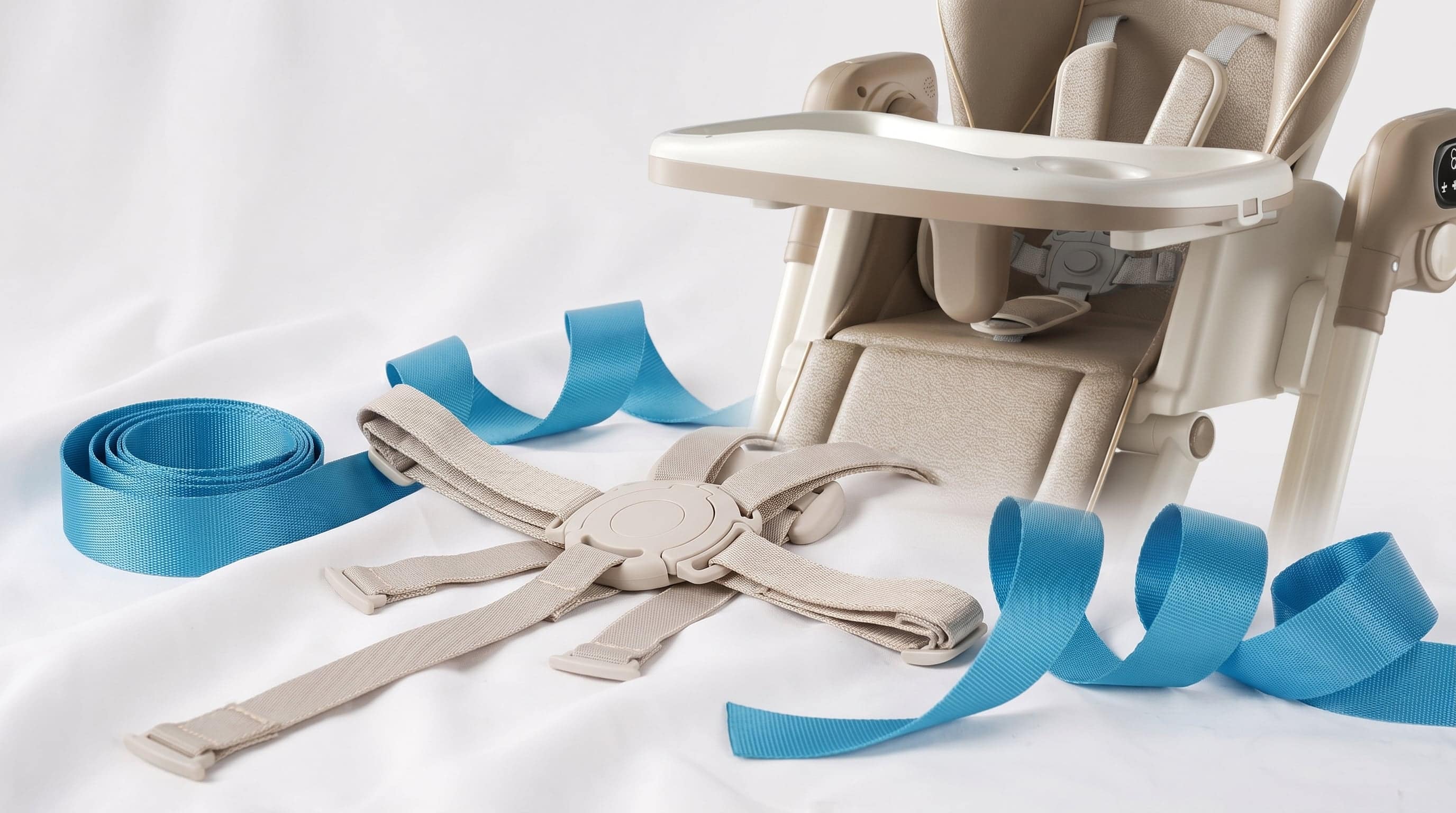
Products · Polyester Webbing
Solution-Dyed Polyester Juvenile Webbing
Engineered for the Single Component That Cannot Fail
The Application Context & Engineering Considerations
A stroller harness must restrain a child during sudden deceleration. An infant car seat harness must distribute crash forces across the smallest possible body. A baby carrier shoulder strap must support repeated dynamic loads for years of daily use, in direct contact with both adult and infant skin.
Each defines a distinct engineering problem. None tolerates webbing failure.
Solution-dyed polyester is the dominant fiber choice for these applications globally — not because it is the cheapest, but because no commodity-grade alternative offers the same combined performance profile.
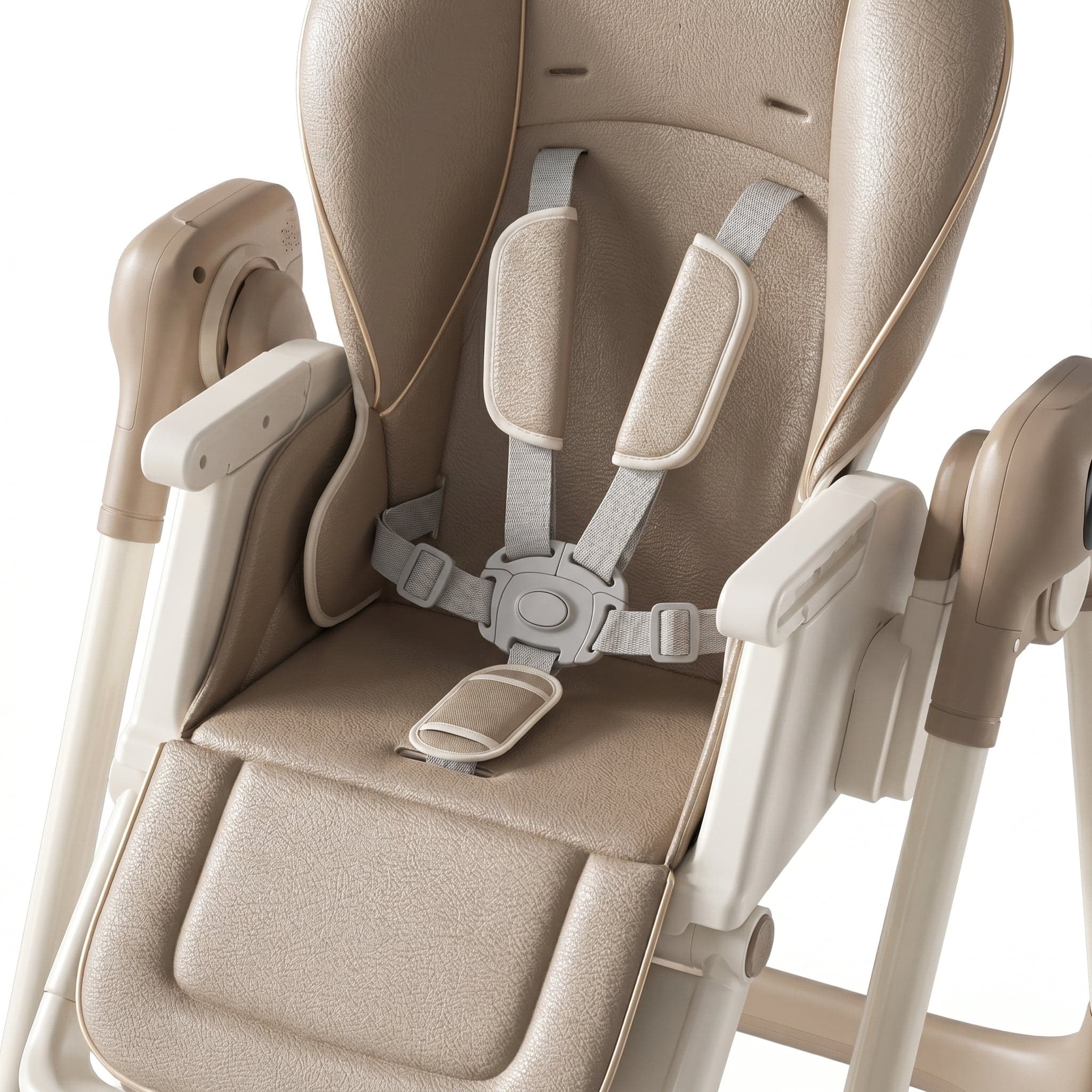
Juvenile webbing differs from general industrial webbing across seven engineering considerations. Each shapes our fiber, weaving, and finishing decisions:
Skin contact compatibility
Juvenile webbing contacts infant skin for extended daily durations. Surface chemistry, residual processing aids, and dye migration become safety considerations. Our solution-dyed polyester contains no migrating dye; finishing is engineered for Oeko-Tex Class I compliance.
Dynamic load profile
A child in motion imposes loads that are not steady-state. Webbing must manage cyclic loading and sudden tension events with predictable elongation. This shapes both yarn selection (FDY for primary load paths) and weave specification.
Compliance traceability
Juvenile brands face regulatory scrutiny. Webbing supply must be traceable from yarn batch through finished product, with corresponding test documentation retained across the full production cycle.
Color permanence under real-world use
A juvenile product is washed, UV-exposed, abraded, and used daily for years. Surface dyes that pass laboratory fastness tests often fail in real-world conditions. Solution dyeing is the only coloring process robust against this profile.
Dimensional precision
A 0.05mm thickness variation that is invisible in fashion may be the difference between a buckle that locks correctly and one that does not. Juvenile webbing requires tighter tolerances than most categories.
Color matching across widths
Juvenile products often combine multiple webbing widths in a single article (25mm shoulder + 38mm waist + 12mm adjuster). Solution dyeing eliminates the dye-lot variation that makes cross-width color matching unreliable.
Aesthetic surface character
Even in safety applications, visual quality affects retail product perception. We weave to maintain consistent surface character, edge definition, and pattern alignment across runs.
Weaving Capabilities
Standard juvenile webbing is most often plain or twill woven in solid colors. Our capabilities extend further.
Jacquard weaving
Integrates patterns, brand markings, and decorative elements directly into the woven structure — at the same load capacity as plain webbing of equivalent yarn count, with durability that printed or embroidered alternatives cannot match.
Multi-color weaving
Combines solution-dyed yarns within a single structure to produce stripes, color-blocked sections, and gradient effects — with the same color permanence as solid-color webbing.
Custom widths and edge profiles
Specified to customer requirement, not selected from stock catalogs.
Post-Processing Capabilities
Juvenile product designers often require webbing processed beyond the loom. We provide three post-processing services in-house:
Ultrasonic cutting
Produces precision-length pieces with sealed, fray-resistant edges — eliminating loose ends and reducing downstream finishing in customer assembly.
Laser cutting
Supports complex shapes, tight tolerances, and clean sealed edges — suitable for tabs, openings, and shaped webbing components.
Pattern engraving
Applies decorative or functional patterns to webbing surfaces — useful for brand markings, sizing indicators, and decorative elements that do not compromise webbing integrity.
These services are integrated into our standard production workflow, not subcontracted. Lead times and tolerances are managed within our facility.
Specifications
Reference Specifications for Juvenile Polyester Webbing
| Property | Typical Range for Juvenile Applications | Test Standard |
|---|---|---|
| Yarn Construction | FDY (load-bearing) / DTY (skin-contact) | — |
| Yarn Count | 300D – 1500D | — |
| Webbing Width | 10mm – 50mm (most common: 25mm, 38mm) | — |
| Webbing Thickness | 0.8mm – 2.5mm | — |
| Tensile Strength (25mm width) | 800 – 2,500 N | ASTM D6775 |
| Elongation at Break | 18% – 25% | ASTM D6775 |
| Color Fastness — Washing | Grade 4–5 | ISO 105-C06 |
| Color Fastness — Saliva & Perspiration | Grade 4 (minimum) | DIN 53160 |
| Color Fastness — Light | Grade 6 (minimum) | ISO 105-B02 |
| Free Formaldehyde | < 16 mg/kg (Class I limit: 16 mg/kg) | ISO 14184-1 |
| Heavy Metals (extractable) | Below Oeko-Tex Class I limits | Oeko-Tex Standard 100 |
| pH Value | 4.0 – 7.5 | ISO 3071 |
| Compliance | Oeko-Tex Standard 100 Class I · REACH SVHC · CPSIA | — |
All specifications are confirmed against customer product requirements before production. Third-party test reports available on request.
Compliance Standards
Juvenile product brands operating in international markets require webbing components to meet a specific set of safety and chemical standards:
Oeko-Tex Standard 100, Product Class I
Articles for Babies and Toddlers — the most restrictive Oeko-Tex class, covering products intended for children up to 36 months.
EU REACH Regulation
Restriction of Substances of Very High Concern (SVHC).
U.S. CPSIA
Consumer Product Safety Improvement Act — total lead content and phthalates restrictions.
EN 71-3
Migration of certain elements (heavy metals) from toys.
California Proposition 65
Chemical disclosure requirements for U.S. market.
Our polyester webbing is engineered to meet these standards across the full production range. Test reports are issued by accredited third-party laboratories (SGS, Bureau Veritas, Intertek) and provided to customers on request.
Typical Applications
- Stroller 5-point safety harnesses (shoulder, waist, crotch straps)
- Infant car seat harness webbing
- Baby carrier shoulder and waist webbing (FDY load paths, DTY contact surfaces)
- High chair safety belts and 3-point harnesses
- Toddler walking harnesses and safety reins
- Stroller wagon safety webbing (Veer / WonderFold-class products)
- Diaper bag straps with stroller-compatible attachments
- Bouncer and swing safety webbing
- Bassinet handle and lift webbing
Inquiry
Polyester juvenile webbing specifications are confirmed against your specific product requirements before production. Custom widths, thicknesses, tensile ratings, and color matches are part of our standard work — not exceptions to it.
Contact Mason directly for technical discussion or sample request.