
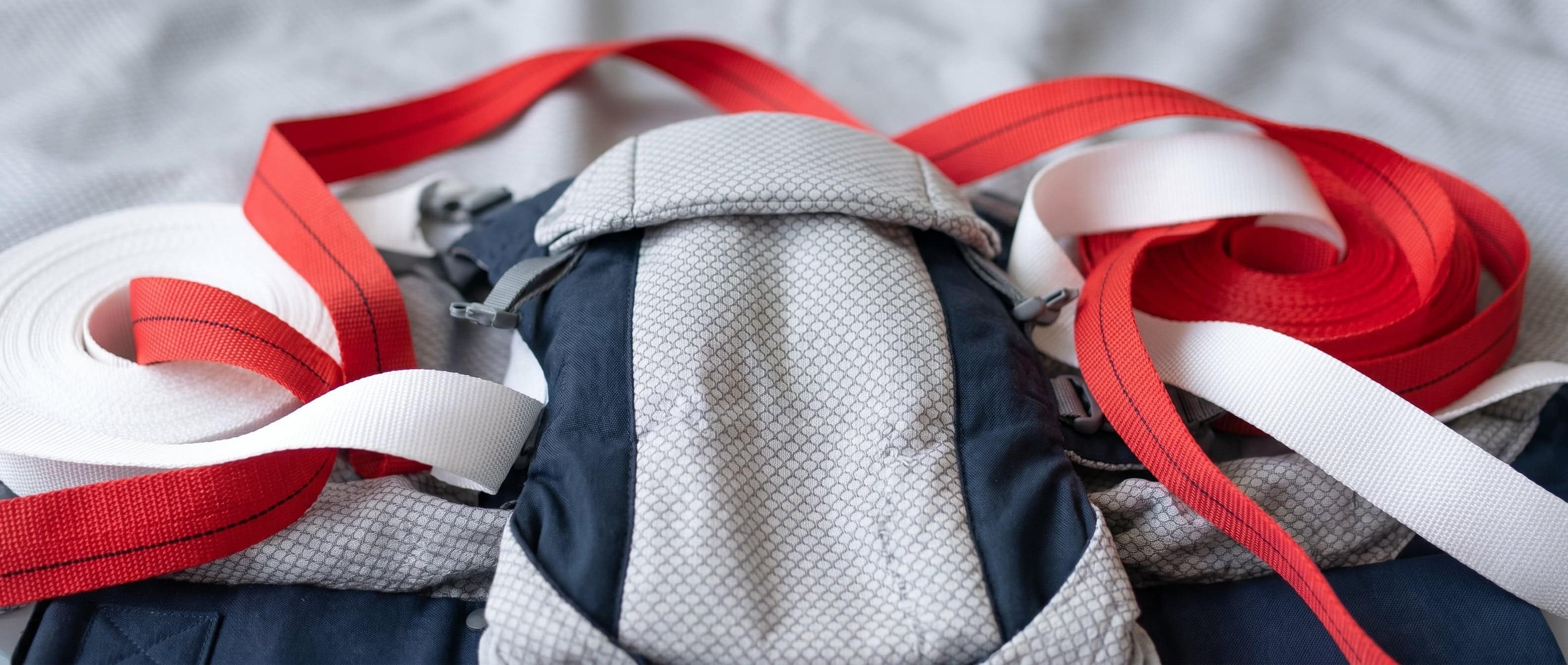
Products · Polypropylene Webbing
Solution-Dyed Polypropylene Juvenile Webbing
The Other Half of the Juvenile Webbing Standard
The Application Context & Engineering Considerations
Most juvenile products use both polyester and polypropylene webbing — chosen application by application against the role each plays within the finished article.
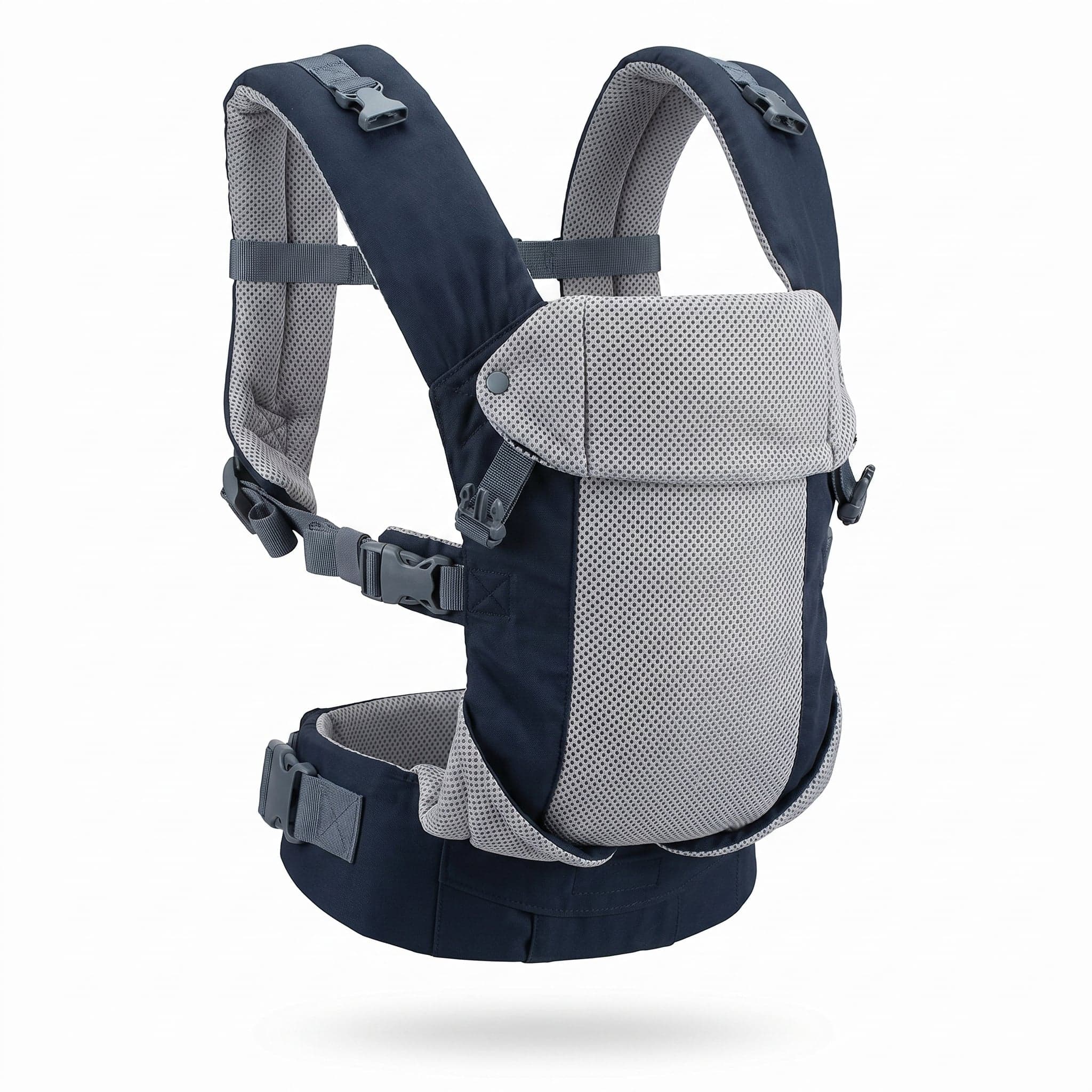
A baby carrier uses polyester for its load-bearing harness and polypropylene for its edge binding and decorative trim. A stroller uses polyester for its 5-point harness and polypropylene for its canopy ties and accessory straps. A diaper bag uses polypropylene shoulder straps because the bag itself is washed, exposed to spilled liquids, and stored in varied conditions where polypropylene's hydrophobic chemistry matters.
The choice between polyester and polypropylene for any specific component is an engineering decision shaped by seven considerations:
Edge binding and trim applications
Polypropylene is the dominant choice for edge binding webbing — narrow widths used to finish the edges of fabric panels in carriers, bags, and accessories. Its lower density and softer hand at narrow widths makes it preferable for this role.
Weight-critical applications
Polypropylene is approximately thirty percent lighter than polyester at equivalent dimensions. For products where weight matters — travel-oriented juvenile gear, outdoor accessories — this is decisive.
Float requirements
Polypropylene's specific gravity of 0.91 means it floats. For juvenile water-adjacent applications — pool and beach gear, marine accessories, products that may contact water during normal use — this is a physical advantage polyester cannot match.
Wet environments and cleaning agent exposure
Near-zero moisture absorption combined with excellent chemical resistance makes polypropylene the right choice for webbing that contacts spilled liquids, repeated cleaning, or sustained humidity.
Mildew and bacterial resistance
The hydrophobic surface chemistry that resists moisture also resists biological degradation — relevant for juvenile products stored in varied conditions or used in tropical climates.
Thermal processing in customer manufacturing
Polypropylene's lower melting point requires customer processing parameters specifically calibrated for polypropylene. Settings transferred from polyester production will damage the webbing.
Compliance traceability
As with all juvenile webbing, regulatory documentation must trace from yarn batch through finished product. We retain material lot identification and corresponding test reports across the full production cycle.
Weaving Capabilities
Standard polypropylene juvenile webbing is most often plain or twill woven in solid solution-dyed colors. Our capabilities extend further.
Jacquard weaving
Integrates patterns and brand markings directly into the woven structure — at the same load capacity as plain webbing of equivalent yarn count.
Multi-color weaving
Combines solution-dyed polypropylene yarns within a single structure to produce stripes, color blocks, and gradient effects — with the same color permanence as solid-color webbing.
Custom widths and edge profiles
Specified to customer requirement, not selected from stock catalogs.
Post-Processing Capabilities
We provide three post-processing services in-house, each calibrated specifically for polypropylene's thermal behavior:
Ultrasonic cutting
Produces precision-length pieces with sealed edges. Polypropylene welds cleanly under ultrasonic energy at calibrated settings — generally producing better edge sealing than polyester at lower processing temperatures.
Laser cutting
Supports complex shapes and tight tolerances. Polypropylene's lower melting point requires precise laser power calibration to achieve clean edges without surface charring.
Pattern engraving
Applies decorative or functional patterns to webbing surfaces, suitable for brand markings, sizing indicators, and decorative elements.
Polypropylene processing parameters differ meaningfully from polyester. We manage those differences within our facility — and we provide processing guidance to customers running polypropylene through their own downstream finishing.
Customer Processing Guidance
Polypropylene's lower melting point requires processing parameters distinct from polyester. We provide the following reference ranges to assist customer technical teams:
Ultrasonic Cutting
- Recommended frequency: 20–35 kHz
- Polypropylene welds at lower amplitudes than polyester — settings must be reduced when transitioning from PET production lines
- Test cuts on production samples are recommended before initial run
Laser Cutting
- Lower power output than polyester required to avoid surface charring
- CO₂ laser settings: reduce by approximately 30% from polyester baselines as a starting reference
- Cutting speed adjustments may be needed depending on webbing thickness
Heat-Based Finishing
- Maximum sustained processing temperature: 130°C
- Brief excursions above 140°C may cause structural deformation
- Avoid steam ironing or high-temperature pressing without test verification
These ranges are reference guidance, not absolute specifications. Final processing parameters depend on equipment make, webbing thickness, yarn count, and finishing requirements. Our technical team is available to support parameter calibration during initial customer production runs.
Specifications
Reference Specifications for Juvenile Polypropylene Webbing
| Property | Typical Range for Juvenile Applications | Test Standard |
|---|---|---|
| Yarn Construction | FDY (all applications) | — |
| Yarn Count | 300D – 1000D | — |
| Webbing Width | 5mm – 50mm (most common: 10mm, 15mm, 20mm, 25mm) | — |
| Webbing Thickness | 0.5mm – 2.0mm | — |
| Tensile Strength (25mm width) | 500 – 1,800 N | ASTM D6775 |
| Elongation at Break | 15 – 25% | ASTM D6775 |
| Color Fastness — Washing | Grade 4–5 | ISO 105-C06 |
| Color Fastness — Saliva & Perspiration | Grade 4 (minimum) | DIN 53160 |
| Color Fastness — Light | Grade 6 (minimum) | ISO 105-B02 |
| Free Formaldehyde | < 16 mg/kg (Class I limit) | ISO 14184-1 |
| Heavy Metals (extractable) | Below Oeko-Tex Class I limits | Oeko-Tex Standard 100 |
| pH Value | 4.0 – 7.5 | ISO 3071 |
| Compliance | Oeko-Tex Standard 100 Class I · REACH SVHC · CPSIA | — |
All specifications are confirmed against customer product requirements before production. Third-party test reports available on request.
Compliance Standards
Juvenile product brands operating in international markets require webbing components to meet a specific set of safety and chemical standards:
Oeko-Tex Standard 100, Product Class I
Articles for Babies and Toddlers — the most restrictive Oeko-Tex class, covering products intended for children up to 36 months.
EU REACH Regulation
Restriction of Substances of Very High Concern (SVHC).
U.S. CPSIA
Consumer Product Safety Improvement Act — total lead content and phthalates restrictions.
EN 71-3
Migration of certain elements (heavy metals) from toys.
California Proposition 65
Chemical disclosure requirements for U.S. market.
Our polypropylene webbing is engineered to meet these standards across the full production range. Test reports are issued by accredited third-party laboratories (SGS, Bureau Veritas, Intertek) and provided to customers on request.
Typical Applications
- Edge binding webbing (carriers, diaper bags, accessory bags)
- Decorative trim and accent webbing
- Diaper bag straps and stroller-compatible attachments
- Stroller accessory webbing (canopy ties, organizer straps, hooks)
- Pet stroller and pet carrier harness webbing
- Lightweight juvenile travel gear straps
- Outdoor and water-adjacent juvenile applications (camping, beach, pool)
- Float-required juvenile applications (pool floats, marine accessories)
- Auxiliary straps in juvenile products where weight reduction matters
Inquiry
Polypropylene juvenile webbing specifications are confirmed against your specific product requirements before production. When polypropylene is the right material — and how to process it correctly — is part of the technical conversation we have at the start of every project.
Contact Mason directly for technical discussion or sample request.